Showing posts with label Tickets for Hockey. Show all posts

Tuesday, 13 December 2011

Hockey Equipment and Olympic Hockey Tickets


Each player carries a "stick", normally between 36–37 inches long, but they make them shorter and longer, and are traditionally made of wood but now often made with fiberglass, Kevlar and carbon fiber composites, with a rounded handle, flattened on the left side and with a hook at the bottom. Metal is forbidden from use in hockey sticks.
There was traditionally a slight curve from the top to bottom of the face side of the stick and another on the 'heel' edge to the top of the handle (usually made according to the angle at which the handle part was inserted into the splice of the head part of the stick), which assisted in the positioning of the stick head in relation to the ball and made striking the ball easier and more accurate. The hook at the bottom of the stick was only recently the tight curve that we have nowadays. The older 'English' sticks had a longer bend, making it very hard to use the stick on the reverse. For this reason players now use the tight curved sticks. The handle makes up the about the top third of the stick. It is wrapped in a grip similar to that used on tennis racket. The grip may be made of a variety of materials, including chamois leather, which many players think improves grip in the wet. It was recently discovered that increasing the depth of the face bow made it easier to get high speeds from the drag flick and made the stroke easier to execute. At first, after this feature was introduced, the Hockey Rules Board placed a limit of 50 mm on the maximum depth of bow over the length of the stick but experience quickly demonstrated this to be excessive. New rules now limit this curve to less than 25 mm so as to limit the power with which the ball can be flicked.
The ball is spherical, hard and made of plastic sometimes over a cork core and is often covered with indentations to reduce hydroplaning that can cause an inconsistent ball speed on wet surfaces.
Many players wear mouth guards to protect teeth and gums from impacts from the ball or stick. Some local rules require their use. Many players also wear shin guards, and again these may be required equipment in some areas. Many players wear Astor gloves: a padded glove which is designed to protect hands from abrasion from contact with the ground especially that of sand-based Astor pitches and some even protect against impact from a ball or a stick. A few competitions require goggles to protect the eyes. Defenders may sometimes use short corner masks; these are designed to reduce the impact of a drag flick from short corners, though they do not provide guaranteed protection.
The 2007 rulebook has seen major changes regarding goalkeepers. A fully equipped goalkeeper must wear a helmet, leg guards and kickers. Usually they wear extensive additional protective equipment including chest guards, padded shorts, heavily padded hand protectors, groin protectors, neck guards, arm guards, and like all players, must carry a stick. However, such a player may not cross the 23 m line, the sole exception to this being if the goalkeeper is to take a penalty stroke at the other end of the field, when the clock is stopped. The goalkeeper can also remove their helmet for this action. However, if the goalkeeper elects to wear only a helmet and a different colored shirt, they may cross the 23 m line if they have removed their helmet and placed it safely off the field of play. If play returns to the circle without them having opportunity to replace the helmet, this player still has "goalkeeping privileges", that is, they are not limited to using their stick to play the ball whilst it is in the circle. The helmet must be worn whilst defending penalty corners and penalty strokes.
It is now also possible for teams to have a full eleven outfield players and no goalkeeper at all. No player may wear a helmet or other goalkeeping equipment, nor will any player be able to play the ball other than with their stick. This may be used to offer a tactical advantage, or to allow for play to commence if no goalkeeper or kit is available. Purchase OlympicHockey Tickets from Global Ticket Market at very inexpensive rates. Olympic Tickets of all types are available at Global Ticket Market. Buy any of OlympicTickets including Olympic Hockey Tickets from Global Ticket Market in easy and secure way and at cheap rates.

Wednesday, 7 December 2011

Germany national field hockey team and Olympic Hockey Tickets


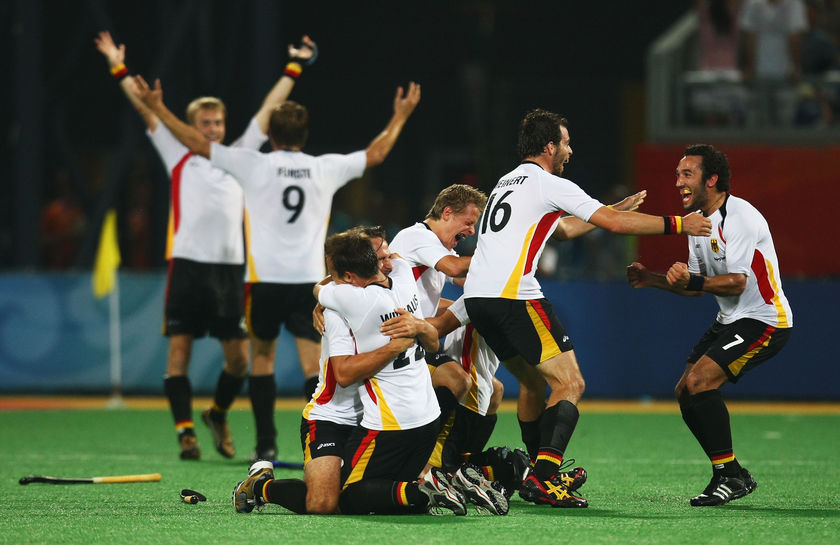
The Germany national field hockey team represents Germany in international field hockey. The team has won the 2006 Men's Hockey World Cup in Monchengladbach, Germany. The team is currently coached by former women's coach Markus Weise, who was appointed on November 6, 2006.
The team caused an upset in the 2002 Men's Hockey World Cup when they defeated Australia 2-1 with striker Olivier Domke scoring the winner after Germany came back from being 1-0 down. After this period the Germans went through a transition period, finishing lowly in the 2003 Men's Hockey Champions Trophy and the 2004 Men's Hockey Champions Trophy with several inexperienced players in their squad. Coach Bernhard Peters was looking to nurture the players for the World Cup, and was successful as the Germans won the 2006 Men's Hockey World Cup, defeating Australia 4-3 in a thrilling final. Players like Christopher Zeller, Moritz Furste and Timo Wess performed exceptionally well. Bernhard Peters left the team in order to pursue a career in football and is now a staff member at TSG 1899 Hoffenheim. The new team coach was Markus Wiese. Success at the 2007 Men's Hockey Champions Trophy and a gold medal at the 2008 Beijing Olympics followed this. Germany headed into the 2010 Men's Hockey World Cup with a largely young and inexperienced squad, with players like Zeller missing, but has reached the final of the World Cup after strong performances throughout the tournament. In the final, they were defeated 2-1 by Australia.
Germany has one of the best youth teams in the World and has won the most Under 21 World Cups. The side has seen constant changes because of the lack of money involved in Hockey. Germany is without the services of Zeller for the World Cup, because he is pursuing a degree in law. Current captain Maximilian Muller has also said that he will concentrate on studies after the 2010 World Cup. Germany will play in the annual 2011 Hockey Champions Trophy, in Auckland, New Zealand. They will compete in pool B along with Korea, Netherlands and host nation New Zealand.
If you want to watch Olympic Hockey, you can buy Olympic Hockey Tickets and enjoy it live in Olympic Games 2012 held in London. You can purchase Olympic Hockey Tickets from Global Ticket Market at very inexpensive rates. Olympic Tickets of all types are available at Global Ticket Market. Buy any of Olympic Tickets including Olympic Hockey Tickets from Global Ticket Market in easy and secure way and at cheap rates.  

Monday, 21 November 2011

Hockey Pitch and Hockey Tickets


Most hockey field dimensions were originally fixed using whole numbers of imperial measures. Nevertheless, metric measurements are now the official dimensions as laid down by the International Hockey Federation (FIH) in the "Rules of Hockey". It is these dimensions that are given in this article, with the imperial units in parentheses.
 The pitch is a 91.40 m × 55 m rectangular field. At each end is a goal 2.14 m high and 3.66 m wide measured from the inner sides of the posts and crossbar, and an approximately semi circular area 14.63 m from the goal known as the shooting circle or D or arc, bounded by a solid line, with a dotted line 5 m in this marking was not established until after metric conversion from that, as well as lines across the field 22.90 m from each end line generally referred to as the 23 m lines and in the center of the field. A spot 0.15m in diameter, called the penalty spot or stroke mark, is placed with its centre 6.40 m from the centre of each goal.
Traditional grass pitches are far less common in modern hockey with mostly hockey being played on synthetic surfaces. Since the 1970s, sand-based pitches were favored as they dramatically speed up the pace of the game. However, in recent years there has been a massive increase in the number of "water-based" artificial turfs. Water-based synthetic turfs enable the ball to be transferred more quickly than on the original sand-based surfaces and it is this characteristic that has made them the surface of choice for international and national league competitions. Water-based surfaces are also less abrasive than the sand-based variety and hence reduce the level of injury to players when they come into contact with the surface. The FIH are now proposing that new surfaces being laid should be of a hybrid variety which require less watering. This is due to the negative ecological effects of the high water requirements of water-based synthetic fields. In the U.S. field hockey is played mostly in the Northeast region of the country.
 Buy Hockey Tickets and enjoy it live in Olympic Games 2012 held in London. You can purchase Hockey Tickets from Global Ticket Market at very inexpensive rates. Olympic Tickets of all types are available at Global Ticket Market. Buy any of Olympic Tickets including Hockey Tickets from Global Ticket Market in easy and secure way and at cheap rates.
Wednesday, 16 November 2011

Hockey Tickets


Field hockey was introduced at the Summer Olympic Games as a men's competition at the 1908 Games in London, with six teams, including four from the United Kingdom of Great Britain and Ireland.
Hockey was removed from the Olympics at the 1924 Paris Games due to the lack of an international sporting structure. The International Hockey Federation was founded in Paris that year as a response to hockey's omission. Men's hockey became a permanent feature at the next Olympic Games, the 1928 Games in Amsterdam. For a long period of time, the South Asian countries of India and Pakistan dominated the Olympics, with either India or Pakistan winning the men's gold medal in every Olympics from 1928 to 1968. Note that in the Olympic Games before 1948, British India included Pakistan. Pakistan and India gained independence in 1947.
Since 1968, various teams from around the world have seen gold-medal success at the Olympics. However, the inclusion of Astroturf since 1976 is noted to have probably contributed to this decline in Indian and Pakistani medals, since the countries that were once dominant on grass have failed to adapt to Astroturf play. Since 1968, several countries in the Southern Hemisphere have won various medals in men's and women's field hockey, including Australia, New Zealand, Argentina, and Zimbabwe. A leading group of teams from the Northern Hemisphere has come from the Netherlands and from Germany. The first women's Olympic hockey competition was held at the 1980 Summer Olympics in Moscow. Olympic field hockey games were first played on artificial turf at the 1976 Montreal Olympic Games.
Buy Hockey Tickets and enjoy it live in Olympic Games 2012 held in London. You can purchase Hockey Tickets from Global Ticket Market at very inexpensive rates. Olympic Tickets of all types are available at Global Ticket Market. Buy any of Olympic Tickets including Hockey Tickets from Global Ticket Market in easy and secure way and at cheap rates.